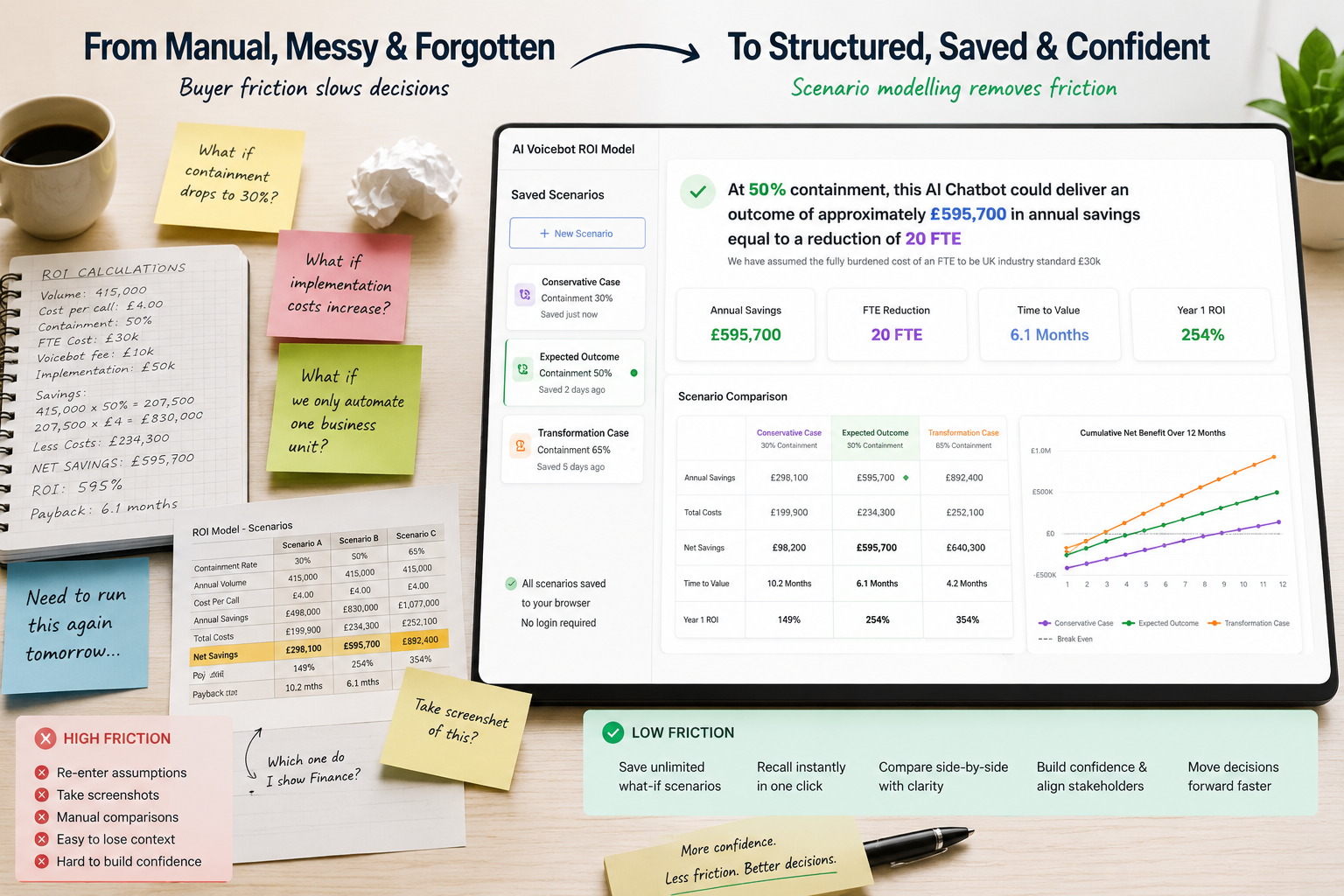
Enterprise Buyers Rarely Accept A Single Outcome
In complex purchases, ROI is rarely linear.
Stakeholders often want to understand multiple possible outcomes before moving forward.
For example:
Finance Teams Ask Conservative Questions
Finance leaders often want to understand downside risk.
Questions typically include:
- What if savings are lower than forecast?
- What if adoption is slower?
- What if implementation costs increase?
- What happens under conservative assumptions?
Their goal is not optimism.
Their goal is confidence.
Operational Teams Explore Practical Scenarios
Operational leaders typically want to test realistic implementation assumptions.
For example:
- What happens if only one business unit adopts the solution?
- What if automation rates are lower than expected?
- What if workforce utilisation improves incrementally rather than immediately?
They want to understand:
What feels operationally achievable?
Procurement Needs Confidence In Variability
Procurement stakeholders often need assurance that a business case still holds up when assumptions change.
They are often evaluating:
- best case scenarios
- expected outcomes
- conservative outcomes
Because enterprise buying rarely happens under perfect assumptions.
The Problem With Most ROI Calculators
Most ROI calculators assume buying decisions happen like this:
- Enter assumptions
- Press calculate
- Review result
- Make decision
But this is rarely how real buying behaviour works.
In practice, buyers revisit assumptions repeatedly.
They compare outcomes.
They socialise results internally.
They return to the model days or weeks later.
And this creates an important problem.
What Happens When Buyers Want To Explore “What If” Scenarios?
This is where friction appears.
Most calculators force buyers to:
- manually write down numbers
- take screenshots
- recreate previous assumptions
- start calculations from scratch
- compare outputs manually in spreadsheets
For complex ROI models with dozens of variables, this quickly becomes frustrating.
What felt compelling five minutes earlier becomes difficult to revisit.
The buyer loses context.
Momentum slows.
Confidence drops.
In some cases, the buying process stalls entirely.
Because instead of exploring value, buyers are now managing admin.
Why Scenario Modelling Reduces Buyer Friction
Enterprise buyers do not want a single answer.
They want confidence in the decision.
That confidence often comes from comparison.
This is where scenario modelling becomes valuable.
Instead of forcing buyers into one assumption set, scenario modelling allows stakeholders to explore:
Conservative Scenarios
What happens under more cautious assumptions?
For example:
- lower automation rates
- reduced adoption
- slower productivity gains
- increased implementation cost
Expected Outcomes
What does realistic performance look like?
This becomes the likely business case.
Best-Case Scenarios
What happens if the organisation achieves higher-than-expected outcomes?
This helps stakeholders understand upside potential.
The result?
A more robust buying conversation.
Because stakeholders stop debating isolated assumptions and begin evaluating commercial confidence.
Why Scenario Saving Matters More Than Most Teams Realise
The real friction problem is not simply scenario modelling.
It is scenario persistence.
Because buyers rarely evaluate ROI in a single session.
They:
- leave meetings
- revisit models later
- return after internal conversations
- compare options over time
- bring new stakeholders into the process
Without persistence, the buyer must recreate work repeatedly.
And every additional step increases friction.
Most ROI Tools Forget The Buyer Journey
Many ROI calculators effectively reset the experience every time a buyer returns.
This creates unnecessary effort.
The buyer must:
“Try to remember what looked compelling earlier.”
That is not how enterprise decisions should work.
Especially when evaluating complex models with many variables.
Scenario Recall Creates A Better Buying Experience
Imagine a buyer evaluating an AI voicebot investment.
They initially model:
Scenario One: Conservative Adoption
- Lower containment rate
- Higher implementation costs
- Reduced operational impact
Then later they explore:
Scenario Two: Expected Business Outcome
- Standard implementation assumptions
- Moderate automation levels
- Realistic productivity gains
Finally:
Scenario Three: Aggressive Transformation
- Higher automation rates
- Larger operational impact
- Greater labour efficiency
Without scenario recall, these comparisons become difficult.
With saved scenarios, buyers can instantly revisit earlier assumptions and compare outcomes side-by-side.
That creates clarity.
And clarity reduces friction.
Reducing Friction Means Removing Unnecessary Barriers
One of the biggest hidden sources of friction in ROI experiences is authentication.
Many tools require:
- registration
- account creation
- email verification
- login credentials
before buyers can meaningfully engage.
This introduces unnecessary resistance.
Particularly in early or mid-stage evaluation.
Buyers Want Convenience
If buyers are simply exploring possibilities, they do not want administrative overhead.
They want to:
- adjust assumptions
- save scenarios
- revisit later
- continue the conversation
without interruption.
A lower-friction experience encourages deeper engagement.
Because buyers remain focused on value — not process.
Why Browser-Based Scenario Saving Matters
One way to reduce this friction is simple:
Save scenarios directly in the buyer’s browser.
This creates a smoother experience because buyers can:
- return later without logging in
- continue exploring assumptions
- revisit earlier scenarios instantly
- compare outcomes over time
The experience feels lightweight.
But commercially, it is powerful.
Because the easier it becomes to explore value, the more likely buyers are to continue the evaluation process.
And in enterprise sales:
Reduced friction often increases momentum.
Enterprise Buying Is Iterative, Not Linear
The biggest misconception about ROI modelling is that buyers want a final answer immediately.
In reality:
Buying decisions evolve.
Stakeholders learn.
Assumptions change.
Confidence develops over time.
The best ROI experiences support this process.
They allow buyers to:
- explore scenarios
- revisit assumptions
- compare outcomes
- build confidence gradually
Rather than forcing a one-time calculation.
The Future Of ROI Modelling Is Buyer Enablement
Traditional ROI calculators were built to calculate.
Modern ROI models should help buyers decide.
That means supporting:
Exploration
Helping buyers pressure-test assumptions.
Scenario Comparison
Making multiple outcomes easy to evaluate.
Recall
Allowing buyers to revisit previous thinking.
Low Friction
Reducing unnecessary barriers like forced registration.
Because the easier it is for buyers to evaluate value:
The easier it becomes for them to justify investment.
And ultimately:
ROI models should not simply calculate outcomes — they should make buying decisions easier.