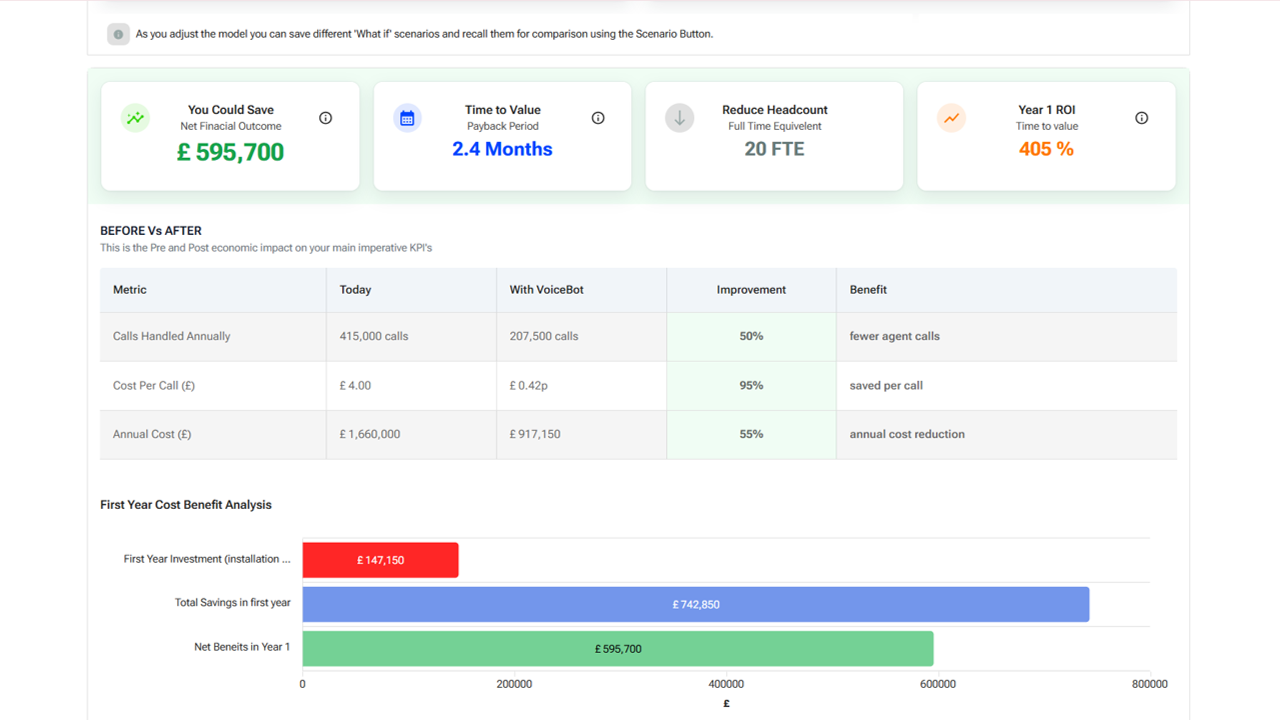
What Is an AI Voicebot ROI Calculator?
An AI Voicebot ROI Calculator helps organisations estimate the financial return from introducing conversational AI into customer service operations.
Many contact centres manage thousands — or even millions — of repetitive customer enquiries each year. Calls relating to order tracking, missed deliveries, account questions, appointment scheduling, or simple service requests often require live-agent intervention despite being highly repetitive.
AI voicebots provide an opportunity to automate many of these interactions.
This calculator helps organisations understand:
- How many calls could realistically be automated
- The cost difference between agent-handled and automated interactions
- The potential reduction in operational spend
- First-year implementation economics
- Expected ROI and payback timeline
Rather than relying on generic assumptions, the model uses your own operational inputs to estimate economic impact. It calculates expected outcomes using call volumes, containment rates, cost-per-call assumptions, and voicebot operating costs.
How This Voicebot ROI Model Works
The calculator estimates financial impact by modelling the difference between your current service costs and a future state where a percentage of calls are fully resolved by an AI voicebot.
The model considers several operational factors:
Annual Call Volumes
The total number of customer calls currently handled each year.
Higher volumes generally increase automation opportunity and can significantly influence projected savings.
Current Cost Per Call
The average cost of a live-agent interaction.
This represents the current operational cost of servicing customer demand. Agent costs often include salary, management overhead, systems, training, and occupancy-related costs
Voicebot Cost Per Call
The estimated cost of handling a customer interaction through the AI voicebot.
This typically includes:
- infrastructure
- AI processing
- telephony costs
- language model consumption
The difference between live-agent and voicebot handling cost is a key driver of ROI.
Containment Rate
The percentage of calls fully resolved by the voicebot without transfer to a human agent.
For example:
If a contact centre receives 500,000 annual calls and the voicebot achieves 50% containment, approximately 250,000 calls may be handled without agent intervention.
Implementation & Subscription Costs
The model also includes:
- installation costs
- annual language model subscriptions
- ongoing platform costs
These investments are factored into first-year ROI calculations to provide a realistic economic picture.
Metrics Explained
Annual Savings
Annual Savings estimates the total yearly operational saving generated when the voicebot handles customer calls at a lower cost than live agents.
The model calculates:
Calls automated × cost difference per interaction
This provides a view of the annual gross efficiency benefit created through automation.
Net Financial Benefit
Net Financial Benefit represents the projected first-year financial outcome after subtracting implementation and operating costs from annual savings.
This helps organisations understand:
“After all costs, what financial outcome could automation realistically deliver?”
This is often one of the most important decision-making metrics for transformation programmes.
Year 1 ROI
ROI measures the financial return generated relative to total investment.
The calculator estimates:
Net financial benefit ÷ total first-year investment
A positive ROI may indicate that automation generates greater value than it costs to implement.
Time to Value (Payback Period)
Payback Period estimates how quickly the investment cost is recovered through realised savings.
This metric answers:
“How long until the solution pays for itself?”
Shorter payback periods are often attractive when prioritising operational transformation initiatives.
FTE Reduction Opportunity
The model also estimates the approximate reduction in staffing demand based on the financial impact generated by automation.
This does not necessarily imply redundancies.
Instead, organisations often use these efficiencies to:
- absorb demand growth
- reduce outsourcing dependency
- improve service levels
- redeploy teams toward higher-value work
Why Containment Rate Matters
Containment rate is typically the single biggest driver of ROI in conversational AI deployments.
A higher containment rate means:
- fewer calls escalated to agents
- lower operational cost-to-serve
- faster service resolution
- stronger automation economics
Even relatively small improvements in containment can materially change projected savings.
This calculator allows teams to model different scenarios to understand sensitivity and business impact before implementation.
Who This Calculator Is For
This calculator is useful for:
Contact Centre Leaders
Evaluate cost-to-serve improvements and automation opportunity.
Operations Teams
Model efficiency gains and demand management scenarios.
Transformation Programmes
Build investment cases for AI-enabled service operations.
Finance Teams
Assess ROI, payback periods, and operational savings.
Consultants & Vendors
Support customer business cases using data-driven modelling.
Frequently Asked Questions
How is ROI calculated?
The model compares projected annual operational savings against total first-year investment costs, including implementation and subscription costs.
What is a good containment rate?
Typical voicebot containment rates vary significantly by use case, conversation complexity, and implementation quality. Simple transactional enquiries may achieve higher containment than complex service interactions.
What has the biggest impact on ROI?
Usually:
- annual call volume
- current cost per call
- containment rate
- implementation costs
These factors tend to have the greatest influence on financial outcomes.
Does FTE reduction mean headcount removal?
Not necessarily. Many organisations redeploy capacity toward higher-value work, improve service levels, or absorb growth without additional hiring.
Build a Stronger Business Case for AI Voice Automation
Whether you're evaluating customer service transformation, reducing operational cost-to-serve, or assessing the value of conversational AI, this calculator helps quantify potential financial impact using your own assumptions.
Start modelling your voicebot ROI and explore different scenarios to understand what automation could mean for your organisation.